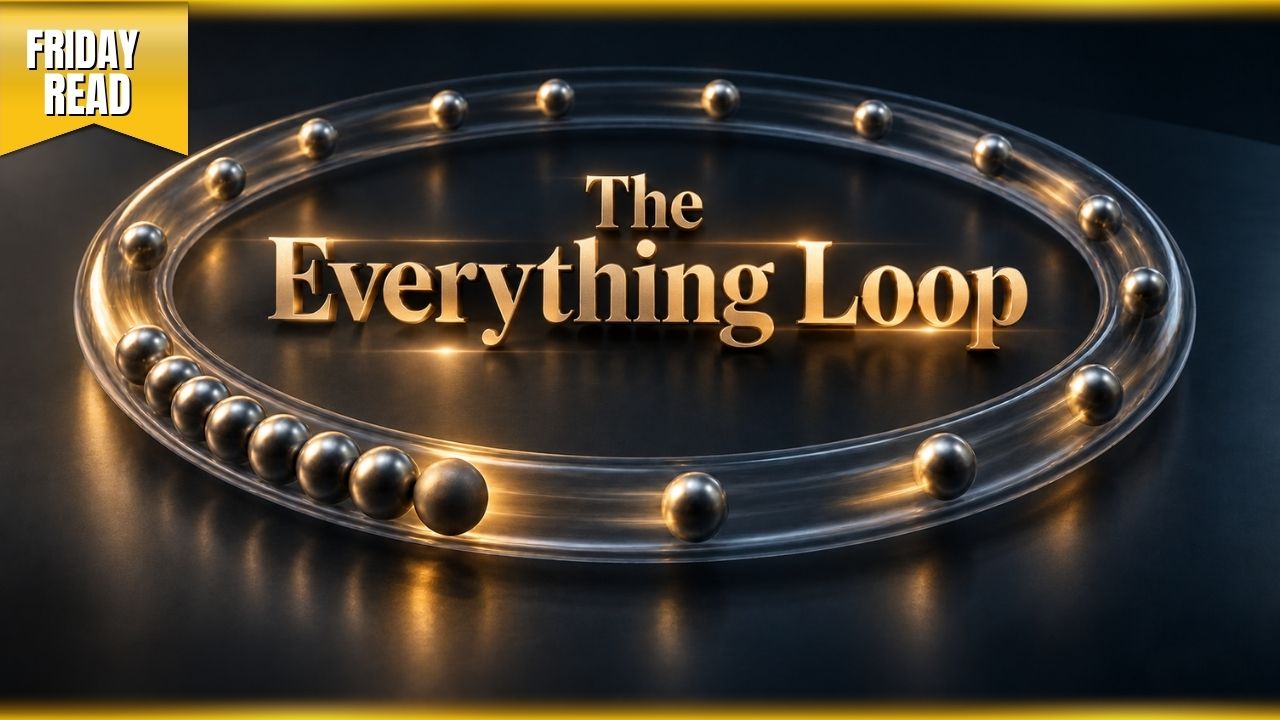
Over the past few decades, we have built perhaps the most sophisticated financial system in history. Capital can move around the world almost instantaneously, risks can be transferred between institutions, and businesses can draw upon enormous pools of money. I call the system that has emerged The Everything Loop.
Financial markets have always been connected to the real economy. What has changed is the speed of those connections, the borrowing running through them, and how much apparently separate markets depend on the same sources of funding. We have shortened the distance between cause and consequence, leaving less time to adjust when something goes wrong.
This is also where we hold most of our financial wealth. Our pensions, shares, bonds, funds and bank deposits depend, to varying degrees, upon this same system.
When conditions are favourable, the connections work beautifully. Cheap capital supports asset prices. Higher valuations help companies raise money to invest, and one company’s investment becomes another’s revenue. Rising earnings support markets, increasing household wealth and encouraging spending. That spending supports businesses, attracting more investment.
Eventually we arrive back where we started: capital creating the conditions that attract more capital. There is no obvious beginning or end. That is The Everything Loop.
Gold To $4,000: Who’s Still Buying?
Making the machine faster
We have spent decades making this system more efficient. Investors can borrow to increase their exposure, use derivatives to manage risks and move money between currencies in search of better returns.
Japan offers a useful example. Decades of exceptionally low interest rates made the yen a source of cheap borrowing. Investors could borrow in yen and put the money into higher-returning assets elsewhere, including US markets. This is the yen carry trade, linking investment decisions in one country to borrowing conditions in another.
AI has given the machine another push. Expectations of future profits encourage spending on chips, data centres and energy. The companies supplying them gain revenue, supporting their valuations and encouraging further investment. AI arrived after financial innovation had already built the Loop, but it helps keep it turning.
There is, however, something unsettling about a feedback loop: it doesn’t care which direction it’s running. The connections that support investment and confidence can also transmit falling prices and fear.
Following one shock around the Loop
Imagine balls travelling around a circular tube. If they move at roughly the same speed, everything works. But when one slows, the ball behind catches it. They collide, disturbing the next ball, which is hit by the one behind that.
Financial markets do not behave exactly like balls in a tube, but the comparison helps. The faster everything moves, the less time there is between the first loss of momentum and its consequences. A problem can spread before anyone has worked out how to contain it.
Start with energy. Suppose a prolonged disruption in the Middle East keeps energy prices higher. For Japan, which imports much of its energy, that increases costs and puts pressure on its central bank to respond to inflation.
If Japanese interest rates rise, borrowing in yen becomes more expensive. Some investments funded by that borrowing become less attractive, prompting investors to sell assets and repay loans. Higher returns at home could also encourage Japanese investors to bring money back from overseas.
Why should this concern an American investor? Some of that money is invested in US government bonds, or Treasuries. If investors sell enough of them, their prices fall and their yields rise. Those yields influence borrowing costs across the American economy. Treasuries also serve as collateral, the assets pledged to secure loans, so disruption can affect lenders and borrowers elsewhere.
That brings us back to AI. Much of the value investors place on fast-growing companies reflects profits expected years from now. Higher interest rates reduce what investors will pay today for those future profits. They also make borrowing to build data centres and other infrastructure more expensive.
Companies do not have to abandon AI for this to happen. Delaying a project or reducing its budget is enough to change what suppliers can expect to earn. Some projects become less attractive, and investment slows. Remember where we started: one company’s investment is another company’s revenue. Suppliers lose expected business, earnings forecasts fall and share prices can come under pressure.
The effects reach beyond Wall Street. Households whose wealth has fallen may spend less, weakening business revenues further. Lenders and investors become more cautious, making finance harder to obtain. Eventually, those tighter conditions arrive back at investment.
We have travelled from energy through Japan, US bonds, AI spending, shares and household consumption, before returning to capital. This is one possible route, not a forecast. Most disturbances will not become systemic crises, but risks we discuss separately can travel through the same connections.
Nor must the original event be bad news. Suppose a Chinese company delivers advanced AI at a fraction of the expected cost. That could be excellent news for users, while undermining the profits investors expected from expensive infrastructure. AI could succeed faster than anticipated and still disappoint those financing it. Once investment plans change, the consequences enter the same Loop.
Where does resilience end?
The system has survived enormous shocks before. During the financial crisis and pandemic, governments and central banks supplied emergency funding and supported markets. It is understandable that investors expect help again.
Yet previous success does not guarantee the next response will work as well. Heavy borrowing leaves less room to absorb losses, while shared investments can encourage simultaneous selling. Political disagreements can delay a coordinated response. The danger is that financial stress spreads faster than the authorities can contain it.
Support also changes behaviour. Lower rates can encourage more borrowing, while expectations of rescue can make investors more willing to take risks. A backstop may solve the immediate problem while leaving the system more dependent on help when the next difficulty arrives.
This is why I believe we may be approaching a tipping point. I cannot identify the trigger or the level at which the system becomes unstable. My concern is the combination of close connections, borrowed money and confidence that someone will intervene if necessary.
We do not know where the threshold lies, but that is very different from assuming there isn’t one. That uncertainty changes how I think about diversification.
Diversifying beyond the Loop
When we talk about diversification, we normally mean spreading money across equities, bonds, currencies, sectors and countries. That remains an important way of managing risk. But if those investments depend on the same funding, borrowing conditions and confidence, how much protection do they offer against trouble in the system itself?
That is where physical gold becomes relevant. Properly owned physical gold is unusual because the metal itself is not another party’s promise to pay. It does not require a company to remain solvent, a borrower to repay a debt or a financial institution to honour a contract for the asset itself to exist.
Gold’s price can fall, and ownership and custody arrangements still need care. Nevertheless, the metal’s independence from a borrower’s promise gives it a different role from many assets within The Everything Loop.
We can continue to participate in the financial system to whatever degree we choose, while deliberately holding part of our wealth outside it. Not because we know when the machine will fail, but precisely because we don’t.
If we cannot know where the point of failure lies, we cannot sensibly keep all of our wealth within the very system whose point of failure we are trying to predict.
Diversification within the system is not the same as diversification from the system. That, perhaps, is the most important thing to understand about The Everything Loop.
Buy Gold Coins

Buy gold coins and bars and store them in the safest vaults in Switzerland, London or Singapore with GoldCore.
Learn why Switzerland remains a safe-haven jurisdiction for owning precious metals. Access Our Most Popular Guide, the Essential Guide to Storing Gold in Switzerland here.
Receive Our Award Winning Market Updates In Your Inbox – Sign Up Here