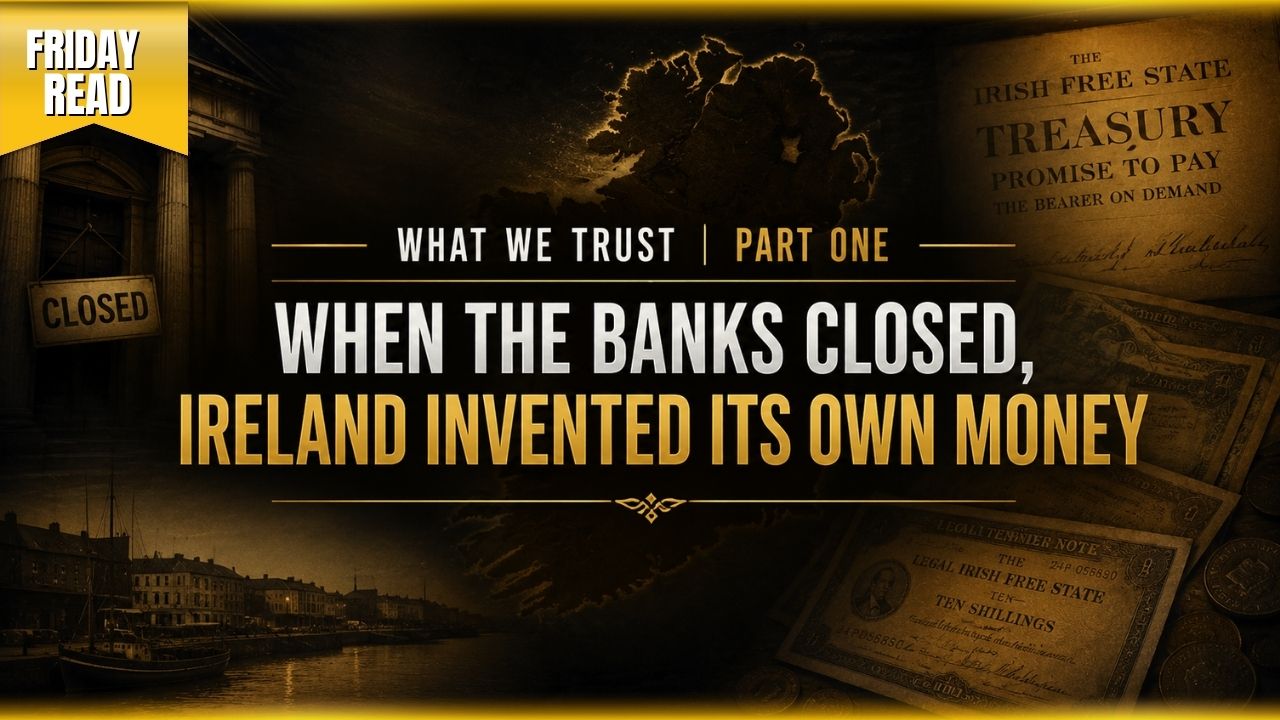
What We Trust
Six true stories about money, ownership and survival
A six-part GoldCore Friday Read series using true episodes from financial and social history to explore what money is, what ownership means, why intelligent people speculate, where wealth becomes safe and what we are ultimately trying to preserve.
On Friday, 1 May 1970, the doors of Ireland’s main banks did not open. A dispute between the Associated Banks and their employees had reached an impasse, and what might ordinarily have been a temporary inconvenience became an extraordinary six-and-a-half-month experiment.
The affected banks formed the backbone of the Irish banking system. They operated hundreds of branches and held roughly 60 per cent of the country’s bank deposits. Without them, cheques could not be cleared in the usual way, deposits became difficult to access and businesses could no longer assume that the machinery of payment would operate in the background.
Heading into such a time one might have expected economic life and the system that supported it to have just seized up, but it didn’t.
Instead, people continued writing cheques and life carried on. Shopkeepers accepted those cheques and then the suppliers passed them on. Publicans, who knew a remarkable amount about the financial habits of their customers, became informal assessors of credit. A cheque drawn by a reliable employer or signed by someone known locally could circulate as though it were money, even though nobody could say precisely when it would finally reach a bank and be settled.
This wasn’t because Ireland had dispensed with money, but because the situation had revealed what money had been resting upon all along.
We tend to imagine that money derives its authority from the institution whose name appears on it. We’ve all had the familiar conversation with those who believe their money is ‘good’ because of a signature on the banknotes. A banknote is trusted because a central bank issued it, just as deposit is trusted because a regulated bank records it. A payment is trusted because the banking system confirms that it has been made. Yet beneath all these arrangements sits something older and less technical and very human: the belief that another person’s promise will be honoured.
China Is Closing Retail Gold Trading. Here’s What It Really Means
During the strike in 1970, that belief came from all the participants, it was a personal state. The publican knew who had a regular wage, who owned the hardware shop and who had a habit of becoming overconfident on a Friday evening. Local knowledge performed part of the work normally done by a bank’s records, risk department and clearing system.
We mustn’t give into the temptation to romanticise this episode as proof that a community can simply carry on without banks. Obviously banks play a role beyond that of day-to-day spending, but the whole system did not collapse. Other financial institutions remained open, sterling continued to circulate and the strike had been anticipated. Most importantly, people believed that the closed banks were solvent and would eventually reopen. Their cheques were delayed claims upon a functioning system, not claims upon one believed to have failed. In short, much of this came down to belief.
The longer the dispute continued, the more difficult it became for households and businesses to know their true financial positions. Cheques accumulated without being reconciled and as the situation rolled on clearly international suppliers became less willing to extend credit. The system adapted impressively, but the strain was growing.
This is precisely why the story deserves more than a cheerful conclusion about Irish ingenuity. It distinguishes between two ideas that are often treated as the same: trust in an institution and trust that an institution will remain available.
In 1970, the banks were unavailable but still trusted because society believed they would reopen once again. They also believed of course that the banks were still ‘good for’ the credit that was being passed around. In a banking crisis, the opposite can occur. The branches may be open and the apps may function, while depositors begin to doubt the promises underneath them. A payment interruption is an operational problem. A solvency crisis is ultimately a crisis of belief. They may look similar from the queue outside a bank, but economically they are very different events.
Modern finance has made trust less visible, partly down to the complicated layers that have been added over the years. We can send money to a stranger in seconds without knowing anything about that person, their bank or the systems connecting us. This is an immense achievement but it also means that many personal judgements have been replaced by a relatively small number of institutional dependencies. We have not removed trust from money, by concentrating and automating it we have removed the personal aspect.
That helps explain why people choose to hold some wealth outside the payment system. Physical gold could not replace the speed or convenience of a current account, nor would one want it to. Its purpose is different. It is an asset that does not depend upon a bank deposit remaining accessible or another party meeting a future payment. It answers one form of trust with a form of ownership.
The lesson of 1970 is not that banks are unnecessary, as time went on Ireland’s experience demonstrated how necessary their clearing and settlement functions eventually become. Nor is it that personal reputation can support a modern global economy indefinitely, again as time went on it couldn’t.
The deeper lesson is that money is never merely the object in our pocket or the number on our screen. It is a network of promises, records and expectations about the future. Institutions allow that network to work between millions of strangers, but the underlying human question remains unchanged: whose word do you accept, and for how long?
For six and a half months, Ireland answered that question across shop counters and public house bars. The banks had temporarily stopped operating, but the trust was still there. The episode reminds us that trust is indispensable to a financial system. Concentrating all of it in one place is not.
Antoin E. Murphy, “Money in an Economy Without Banks: The Case of Ireland,” The Manchester School, 1978.
Malte Krüger, “Money and Credit: Lessons of the Irish Bank Strike of 1970,” 2017/2018.
Central Bank of Ireland, Survey of Economic Effects of Bank Dispute, 1970, published 1971.
Buy Gold Coins

Buy gold coins and bars and store them in the safest vaults in Switzerland, London or Singapore with GoldCore.
Learn why Switzerland remains a safe-haven jurisdiction for owning precious metals. Access Our Most Popular Guide, the Essential Guide to Storing Gold in Switzerland here.
Receive Our Award Winning Market Updates In Your Inbox – Sign Up Here